Why Heated Rivalry is Motivating Me to Write
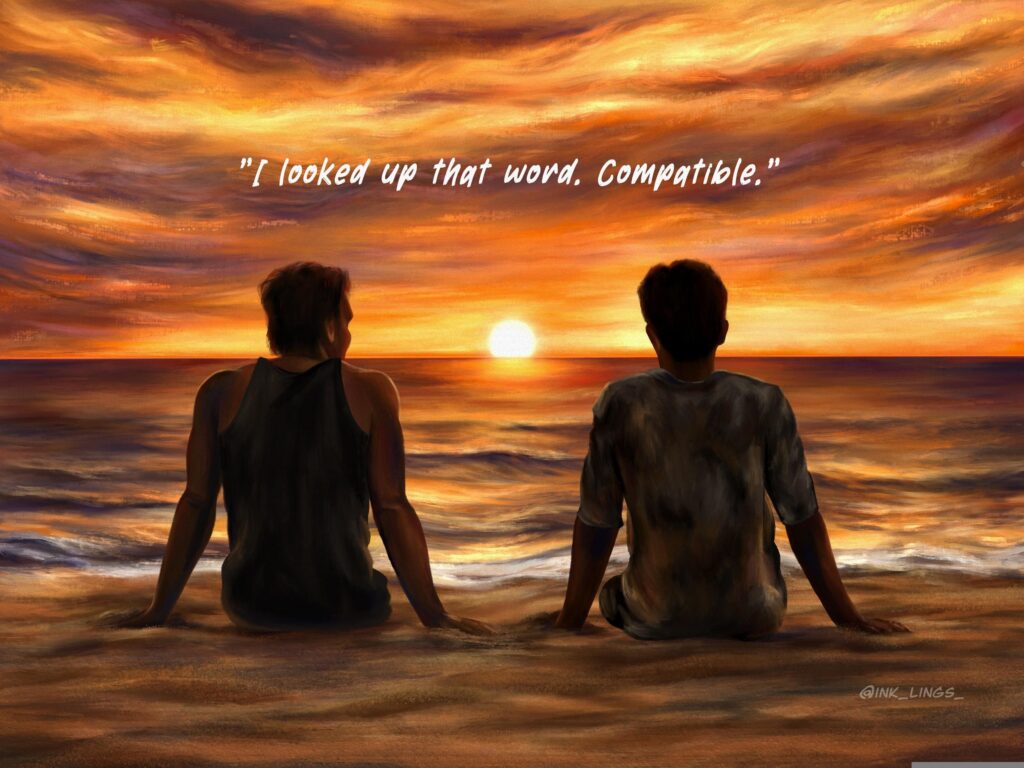
Painting by @ink_lings
It’s rare that autistic queer people of colour are comforted and loved on TV as tenderly as Ilya comforts and loves Shane in the show Heated Rivalry, based on Rachel Reid’s novel from her MM romance series The Game Changers and adapted by director Jacob Tierney for Crave. Without spoiling too much, I will say—after the buzz and memes and fan art and fan edits and videos of HudCon being goofy-cute and fujoshi discourse and millions of TikTok skits subsides (though they are not at all subsiding)—what remains powerful and resonant for me about this queer romance story is the promise and fulfillment of unconditional love amidst an irredeemable world of capitalist imperialist white supremacist cisheteropatriarchy. It shouldn’t be too hard to ask: stories of queer joy, love, and care not centred on violence, trauma, or lack of fulfilment.
Perhaps telling joy-centred stories feels trite for some—after all, Heated Rivalry the series is adapted from a book within the romance genre, which come with reliable and predictable tropes and are often structured as feel-good escapism and fantasy. However, the impact the show is having on broad scales, stemming from an emotional centre rooted in vulnerability and a desire to grow with others in love, clearly screams that, collectively, we are joy-starved and love-starved, as bell hooks argues in her always relevant book All About Love: New Visions and as I continue to believe we are. Just look at where our taxes (yes, including the ones in so-called Canada) are going: bombing weddings in Gaza, ripping families apart, starving children, and stealing lands both here and abroad. Just look at ICE killing people in broad daylight (RIP Keith Porter and Renée Nicole Good) and outside of public scrutiny. Just look at police across North America doing the same. Both with complete impunity. Just look at the hostile architecture outside preventing people from getting a good night’s sleep, when they have already been systemically abandoned. Just look at generative AI destroying our planet on the backs of enslaved Kenyan labour. Colonial violence rules our world, and there is nothing more unloving than that.
One of the first “queer” movies I watched (if we discount Brokeback Mountain) was the truly terrible and exploitative Blue is the Warmest Colour. A few years later, I watched The Handmaiden—a beautiful movie with a brutal historical backdrop that makes it hard for me to want to revisit too often, despite its satisfying narrative arc and gorgeous cinematography. I absolutely adored Moonlight, and of course, the lack of fulfillment and pain in this story is palpable and difficult to revisit for its own reasons. A few years later, I watched Tangerine, which was a thrill, but it was a film that still felt crowded with the unwelcome presence of white cishet men enacting violence and disrespect against trans women of colour. A friend of mine shared that she didn’t want to watch I Saw the TV Glow because, at this time of her life and transition, it would be too painful. I really enjoyed this film but it’s… horror. Saving Face didn’t have a happy ending, either. Happy Together is not… uh, happy together. One of my favourite queer movies is the Taiwanese film Dear Ex, but oh gosh, it is so sad.
In other words, a lot of queer films I’ve seen (which seem slim, I’ll admit) aren’t comforting. They don’t make you feel good. They are difficult, in the ways that I often look for in poetry, because queer lives have been made deliberately difficult by a transphobic and homophobic world rooted in imperialism, colonization, and exploitation. Love and grief are always connected, but gosh, does grief have to oversaturate? I have still not finished watching Pose, partly because watching terrible things happen to Black trans women and other queer people during the 80s, at the height of the AIDs epidemic, feels…terrible. I want to become invested in queer characters who live joyous lives and who get to live to old age because I want that to happen to us, in real life.
Last year, Black trans woman activist and Stonewall legend Miss Major passed away. Miss Major was disabled and supported Palestine (I screamed a little when she retweeted one of our Crips for eSims for Gaza tweets! Of course she would, but – but – still!). I hope Miss Major, Patty Berne, Lilac Vylette Maldonado, Alice Wong (who was not queer but was an ally who loved her TV) are watching Heated Rivalry from the stars, or doing something equally indulgent and joyous. Queer people, trans people, disabled people, Black people, Indigenous people, people of colour, fat people, migrants, people who use drugs, HIV+ people, sex workers, poor people, and so on, are all subject to eugenics, a violence that says they need to change who they are to deserve life, love, and stability, a violence that insists they have to prove being worthy of safety, a violence that casts so many as unworthy of the possibility of thriving and joy.
We have got to take care of our elders, youth, and each other, when we are still here.
My friend Elly Belle poignantly asks in their essay “the beauty of queer love in ‘Heated Rivalry’ (and the limits of representation)”: “Now, the hard part is… how will you get to that fulfillment? What foundations will you build today? What relationships will you tend to? Who will you make a tuna melt or buy ginger ale for? Who will you turn the light on for? How will you stop hiding? How will you help hide anyone who needs it? Whose hand will you hold while you do a challenging thing, or help them face one?” Care work and mutual aid have become a routine part of how I spend my time, but it is a kind of routine that shouldn’t be seen as exceptional or relegated to a chosen few of “real organizers,” as I discuss in my essay “Ritual and Repetition.” What the world at large can learn from queer disabled people of colour are our care practices, apt to the title of Leah Lakshmi Piepzna-Samarsinha’s forthcoming book, The Way Disabled People Love Each Other. I want to see more of that on screen, both within and outside of romance. I want to see that off screen as well. It’s as actor Hudson Williams, Kamloops-raised Korean Canadian ball of ADHD chaos (who may have been your server at the Old Spaghetti Factory in New West), who plays Shane Hollander in Heated Rivalry, says in Harper’s Bazaar:
There is a very fervent, loving community around you. No matter how alienated you feel, there are loving arms ready to hold you. Whether that’s your direct family, or those are some new friends you’ll make, or people across borders that you don’t even know, but that would be willing to take you in and love you for who you are—that exists, that’s not a fairy tale, that’s not fantasy, that’s just what you deserve.
That’s just what we deserve: networks of care and real, palpable love that withstands the systems that control and diminish us.
Heated Rivalry doesn’t turn away from the realities and pains of being queer—specifically, the experiences of closeted bisexual and gay men in the professional hockey world, but while using the same cinematic techniques often used to anticipate queer tragedy, it delivers tenderness and hope instead. After two years of an escalated genocide in Gaza, six years of an ongoing pandemic, multiple concurrent genocides in Sudan, Congo, and beyond, proliferating climate disasters, and the ongoing fascist violence within the imperial core, many are longing for tenderness and hope in their lives. And that is what stories, film, and media can offer. Writing, I suspect, can be its own form of care practice, for both readers and writers alike.
In university, I made one narrative short film with others. After writing the script and directing actors according to the vision we had, I realized the intensity of what I wanted to portray really affected me. The scene in question only took a few takes because frankly, I couldn’t have handled witnessing more. As a poet, I write about gruelling stuff (the latest poems I have put out in the world have all been about Unit 731 and eugenics!). But Heated Rivalry is making me want to revisit writing fiction. And it’s making me reflect on why I liked writing fiction when I was younger: not to brutalize the reader or even make them think, but to simply express myself, to explore interesting characters and sides to myself, to exercise my imagination, and make something that hasn’t yet happened (but should) in the world.
For better or for worse, I’m a weirdo who likes to write and read weird stuff. Weird as in, sad. Weird as in there’s going to be trauma and violence. Weird as in surreal, experimental, and five people will read it. Weird as in I probably won’t be a national bestseller because, look, I’m an organizer who challenges institutions (but shouldn’t we all?) and I don’t know if I want that. No trend or promise of popularity motivates me to change who I am to my core. But Heated Rivalry is changing how I think about what I can do as a queer autistic writer who wants to dream of and build something better than the violence I grew up with and continue to experience. There aren’t always answers for the horrors of the world but writing love like we never should have been deprived of it isn’t frivolous. It’s an antidote to resignation and despair.
I am tired of the narrative that most of Heated Rivalry‘s audience consists of straight woman. As a millennial immigrant who moved to so-called Canada in the late nineties, I was deeply moved by the passage of time depicted in the show and book which directly mirror and echo my own growth as a young person throughout the late aughts and thereafter. My first languages aren’t English and there is a specific kind of intimacy I find myself only expressing, and more easily expressing, in Mandarin, that the show captures so beautifully through Connor Storrie’s portrayal of Ilya too. These elements of the show, along with the incredible chemistry between Connor and Hudson, the iconic soundtrack, and lush cinematography helped me see myself in both Ilya and Shane deeply, with a dash of gender envy mixed with a good ol’ bisexual, “Oh they are hot” mixed with the most important take away—that I deserve this kind of tenderness, love, care, and commitment, too.
It is important to me that queer fans of queer media, especially those who are also trans, racialized, and disabled, are not continuously exploited for our dollars while dismissed for our insights, critiques, desires, and lived realities. Let us not forget that Rachel Reid is disabled and was only able to get specialist care for her Parkinson’s—after being on wait lists for years—because of the fame and praise she garnered from the TV series’ popularity. I am extremely happy for Rachel, and, also, this reality of care rationing within the healthcare system is unacceptable. People shouldn’t have to be famous to get the care they need, something Alice Wong understood deeply: that being granted momentary social capital fails to protect us collectively as disabled people. Yes, we need to critique the Canadian healthcare system because it too is built on colonialism, capitalism, medical racism, and ableist violence leaving people to die.
The conversations that have sparked between friends and me about Heated Rivalry have spanned the realities of being visibly autistic in Hollywood and in the film industry, Soviet music history, linguistic imperialism, rape culture within the hockey world, body dysmorphia and fitness culture, Asian exclusion in Canadian hockey history, and much, much more. Fans are not only here for the decadent sex scenes, which should be considered art in themselves, but even if we are, the ridicule and scorn directed at queer erotic cinema/fiction/art speaks to how truly destitute mainstream society is that gay sex and romance aren’t held up as one of many expressions of human beauty and joy. Yet, we have decades of media of normalized on-screen rape and intimate partner violence. Western media glorifies military and carceral violence and requisite forms of toxic masculinity. Sports as an entertainment industry is in lockstep with this glorification. Just look at Florida Panthers’ visit to the White House, and the deliberate choice of attire to mimic the U.S. President’s style.
Ilya and Shane love each other across time zones, borders, and language; they find each other again and again within the highly restrictive, patriarchal, hyper-masculine environment of hockey culture where they are pitted against each other as rivals. A DL situationship to boyfriends choosing to be together despite the odds. They learn, eventually, how to communicate beyond the language of chirping. They’re kinky, earnest, and sweet, and we as readers and viewers want more. In real life, this fearful, closeted life is at least several former NHL and professional hockey players’ stories. The pain and courage this show is bringing up for these former players is clear: the NHL and hockey world at large normalize toxic environments of systemic homophobia that violently punishes players outside its bounds. If people are scandalized by Heated Rivalry but not the prevalence of sexual violence within the hockey world, it is because the capitalist machine of professional hockey and the world at large runs on and benefits from rape culture. I recently learned from a friend that a hockey strike in the NHL a few decades ago reduced the incidence of sexual violence for an entire season. Sports culture, arising from a history of eugenics, is guilty of promoting patriarchy and rape culture regardless of what a court of law determines about individual players accused of sexual assault. It is ultimately a culture of power and domination. And that is what empire requires.
Queer stories and media gaining widespread popularity doesn’t change the realities of our lives, especially not overnight. Trans exclusion remains normalized within sports in Canada and throughout the world. The notwithstanding clause has been used in the province of Alberta as an attempt to bar trans kids from accessing gender-affirming healthcare. But the impact of this show on our collective psyche is palpable, even if what it ultimately amounts to for most of us is a moment of respite and relief, western society becoming more familiar with fujoshi culture and BL, some very talented people (Hi Hudson hi Connor) becoming very famous, and many nuanced, multi-layered conversations about what hockey culture really is. I remain skeptical and suspicious of the soft power of Canadian media exports; Mark Carney’s government has invested a significant amount of their latest budget into AI, the military, and the extraction industry, while rarely if at all tangibly resisting U.S.’s meteoric rise in fascism (I do not count his World Economic Forum speech as tangible resistance!!). But I feel something else as well: a tentative hope that more people will prioritize love and creativity in their lives, that more people will let themselves become who they are, that more people will use the joy and relief and excitement they feel from Heated Rivalry to fuel fights against injustice and for liberation, because I know I certainly will.
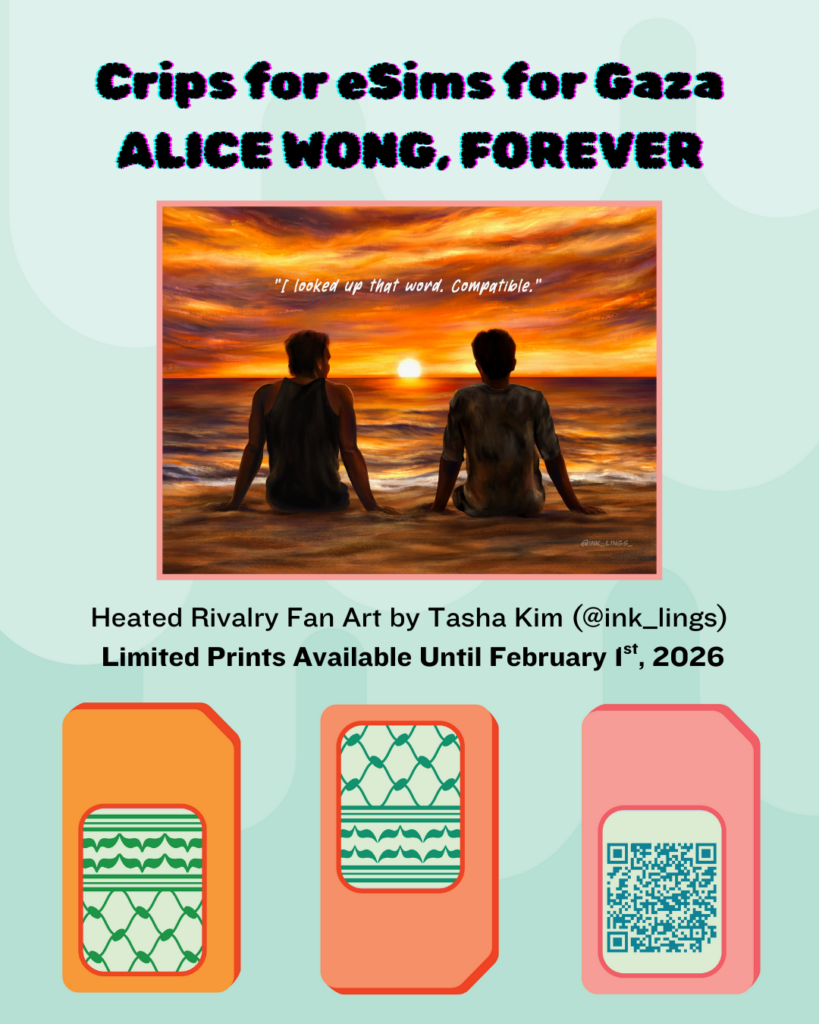
“Crips for eSims for Gaza
Alice Wong, Forever” in bubbly fuzzy black text
Painting surrounded by a pink border of Ilya and Shane looking out at a sunset on a beach. Both their hands are in the sand, two close to touching. Words above them read “I looked up that word. Compatible.”
Painting by @ink_lings
“Heated Rivalry Fan Art by Tasha Kim (@ink_lings)
Limited Prints Available Until February 1st, 2026”
Three orange-, blood-orange- grapefruit-coloured SIM cards, the second one upside down, both with green and white kufiya patterns inside where the SIM chip is. Inside the last SIM card is a green QR code.